When Pam Nicholson was diagnosed with breast cancer in 2020, she sought exceptional care and guidance from Siteman Cancer Center, though she lived far from her hometown of St. Louis. Today, she’s healthy and grateful, which is why she’s giving back to make sure others have the same chance at a healthy life like she has.
Breast Cancer Diagnosis Derails Retirement
After Pam graduated from University of Missouri-Columbia, she started on the fast track at Enterprise to southern California for 12 years where she became a regional vice president for the company.
Over the next 20 years, she moved to St. Louis, then to New York, and back to St. Louis again as she played critical roles in the company’s growth. Ultimately, she became Enterprise’s first female CEO—and the first non-family member to become CEO.
“It was a wonderful career with a wonderful company,” Pam says. After 38 years with Enterprise, she retired at the end of 2019 and moved to Florida to live full time with her husband, Cal. However, her first year of retirement was anything but a day at the beach. First came the pandemic of 2020. Then, Pam was diagnosed with breast cancer in the fall.
In the face of uncertainty, Pam’s unflappable leadership skills quickly emerged from retirement. “When they tell you that you have cancer, you feel like you’ve just been punched in the stomach,” Pam recalls. “But I’m the kind of person who says, ‘OK, it’s another challenge in my life. Let’s see what the options are and what we have to do to fix it.’”
 Finding a Jewel in St. Louis
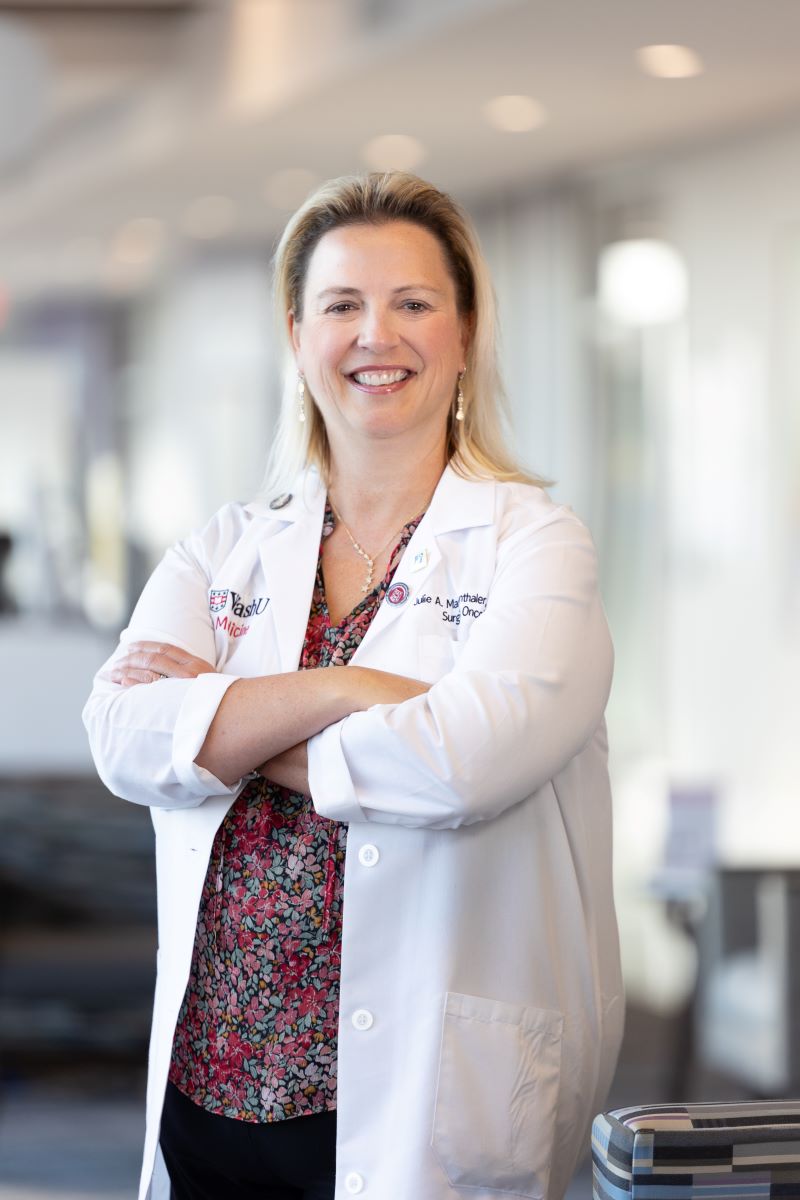
As she weighed her options, a friend who is a doctor recommended that Pam see Julie Margenthaler, MD, FACS, the director of Breast Surgical Services at Siteman Cancer Center.
“My friend told me Dr. Margenthaler is one of the best breast surgeons in the country, so there was no question in my mind she was the one who was going to do the surgery for me,” Pam says.
Genetic tests discovered Pam had the hereditary BRCA2 gene mutation, which put her at higher risk for a spectrum of cancers, including breast, ovarian, and pancreatic cancers.
Her breast cancer was caught early, so Pam decided to have a lumpectomy to remove the mass, which she felt was the “easiest, fastest, and least invasive solution.”
A year later, tests found another lump. Although it was benign, Pam says knowing she had the gene mutation that put her at high risk forced her to make some hard decisions. “I realized I couldn’t live in fear every day that I’m going to get breast cancer again. I needed to be more proactive, so I had a double mastectomy with Dr. Margenthaler. And now I’m breast cancer-free.”
Pam felt the travel from Florida to St. Louis for care was worth it. “From living in St. Louis, I knew Barnes-Jewish is a great hospital and that Siteman is also a fantastic cancer center, but I had never experienced them for myself. I feel very lucky I was able to go there and be under Dr. Margenthaler’s care.”
She especially appreciated Dr. Margenthaler’s compassionate approach. “You’re in such a vulnerable position when you’re first diagnosed,” Pam says. “Dr. Margenthaler is just that right person who is so calming, and she instills confidence. Your doctor matters, and where you go matters. I think Dr. Margenthaler is a jewel for the hospital, for St. Louis, and for all the Midwest.”
Driving Treatment Improvements
Grateful for her physician and compassionate, skilled care, Pam established the Julie Margenthaler MD Breast Cancer Fund, which supports patient care, education and training, and research in breast cancer, including Dr. Margenthaler’s research in cryoablation, a potential alternative to breast cancer surgery.
“I have the utmost respect for Dr. Margenthaler and her dedication as a research scientist to improve everything about breast cancer,” Pam says. “I was impressed with her determination to come up with solutions other than surgery, so I was excited to support this work with cryoablation.”
Pam is championing efforts to raise funds to fully support the establishment of the Endowed Chair for Surgical Excellence in Breast Cancer through The Foundation for Barnes-Jewish Hospital in honor of the extraordinary care she received from Dr. Margenthaler. The endowed chair will provide Dr. Margenthaler a permanent and reliable funding stream to fuel breast cancer research and discovery.
Pam recognizes her care may have looked very different 10 or 20 years ago when most breast cancer patients received the same treatment. “They’ve learned so much more and now make the treatment fit the person. I’m very pleased with the progress that has been made in that area, and Dr. Margenthaler is a big part of making sure women get the right, individualized care at the right time.”
Pam now uses her experience to help other women on their cancer journeys by mentoring and counseling them. “It’s scary when you’re first diagnosed,” she says. “I want to make sure women have eyes wide open and know all the options that are available.”
Because she has painfully lost friends from breast cancer, Pam says she feels like one of the lucky ones. “You wake up thinking it could have been a whole lot different. That’s why I try to live every day to its fullest and appreciate everything life has to offer.”
Inspired by Strong, Vocal Patients
Like Pam, many patients with breast cancer have expressed heartfelt gratitude and created lasting bonds with Dr. Margenthaler over her nearly 30 years at Siteman Cancer Center. While her advanced surgical skills are nationally renowned, patients appreciate her calm, caring approach, and they still inspire her to do more.
“I think breast cancer patients are stronger than they give themselves credit for. They manage to navigate their own illnesses while still taking care of all these other people in their lives and keep their lives going,” Dr. Margenthaler says. “I just love the patients. We created these survivors who are very vocal. They’re sort of our best lobbyists when it comes to treatment and care. That part is very rewarding.”
The endowed chair support from Pam Nicholson and others enables vitally important work now and for the future that will have a huge impact on patient care.
“This endowed chair will allow us to continue to push the envelope in research that we’re doing for advances to come 10 or 20 years from now. It will allow us a regenerating mechanism for research and specifically for research that may not be traditionally funded by the National Institutes of Health (NIH). It also creates a legacy that will allow us to recruit the best people to our section who want to continue our mission.”
Surgical Excellence Built on Collaboration
Dr. Margenthaler says the chair represents Siteman Cancer Center’s commitment to being the best in breast surgery and patient care.
“One of my goals is to establish a center of excellence in breast surgery for the region and even nationally to make it clear to patients that there’s an advantage to being at Siteman for your care. There’s a difference in the full multidisciplinary package we can offer to patients that puts the stamp on that level of care we’re providing. I always tell people a mammogram is not just a mammogram. It makes a difference who is reading your mammogram.”
She says the collaboration between medical oncology, radiation oncology, and surgical experts at Siteman Cancer Center is key to the best patient outcomes.
“Breast cancer is a unique cancer that depends on the patient’s disease or biology of their tumor. The care can be very different for each patient.”
Most breast cancer patients start with the surgeon. Dr. Margenthaler explains that the process evolved that way because there wasn’t effective chemotherapy for breast cancer until the mid-1990s, so the only option was to cut out the tumor. The surgeon was the entry point.
However, that outdated approach of assuming surgery is necessary first can affect a patient’s overall prognosis and survival, Dr. Margenthaler cautions.
“Sometimes, the medical oncologist may need to do chemotherapy before surgery. And I may need to do certain aspects of the surgery in a way that allows the radiation oncologist to use a different form of radiation that has significantly less toxicity. As the surgeon and the entry point, I have to understand all the aspects of treatment to be able to explain what’s involved to the patient.”
She continues: “We’re fortunate to have colleagues we can discuss those things with in real time so we don’t have to make decisions in a vacuum. We bring these experts together to make a treatment plan. This collaboration at Siteman helps us personalize the care for the patient and make sure we’re providing the best care—because breast cancer changes very rapidly.”
The combination of breast surgery expertise, the level of imaging, medical oncology, genetics and pathology expertise, along with the clinical trials offered, are part of what makes Siteman Cancer Center exceptional, Dr. Margenthaler adds. “Siteman is unique because we have all the aspects that put it together.”
Pathway to Progress
Thanks to research, breast cancer treatments—and survival rates—have improved significantly over the past two decades. At the same time, treatment is evolving with a “less is more” approach.
Dr. Margenthaler sees many reasons for hope on the horizon. She is most excited about the successful targeted therapy now available that opens the door for more treatments.
When she first started practicing 20 years ago, patients with HER2+ breast cancer only had a 50-65% survival rate. New targeted drugs, including Herceptin, have increased that survival rate to 95-98%, even in patients who have locally advanced disease.
“Being able to sequence the cancer, understand the genomics of the cancer, and then identify these targets is helping us develop better immunotherapy and better ways to combat this type of breast cancer,” Dr. Margenthaler says.
Breast cancer surgery also continues to evolve with less invasive approaches.
“For breast surgery, our evolution has been to do less and less and get the same outcome,” Dr. Margenthaler says. “We can do that because of earlier detection and more effective therapy. What I did 20 years ago and what I do today are dramatically different, from how much tissue we’re removing to how many lymph nodes we’re removing. The surgery is just one part of it. You really have to know how to put it all together to make sure we get the best outcome.”
And philanthropy helps put it all together, making that personalized treatment approach possible.
“The research that needs to be done on breast cancer is endless,” Pam says. “Right now, we are just scratching the surface. Dr. Margenthaler will use her leadership and research skills to enable innovation and discovery to improve the standard of care, make progress in solutions and cures, and help save lives. That’s the ultimate goal: saving lives. That is why I will continue to support the efforts behind breast cancer to help other women the way I was helped.”
Written by Joyce Romine
Photography by Gara Elizabeth Lacy