As a head and neck cancer survivor, Joe Koenig continues the fight to help others by rallying support for the new Head and Neck Tumor Center at Siteman Cancer Center.
 Pushing through pain is Joe Koenig’s M.O. During his senior year of college playing soccer at Saint Louis University, he endured 24 stitches in his head, two concussions, a broken ankle, a broken toe, and a torn ligament in his knee. Yet nothing could keep him down. He always relentlessly trained to get back in the game as soon as possible.
Joe has carried those values of teamwork, commitment, discipline, and hard work with him to build a successful career and ultimately become president of World Wide Technology, a global technology solutions provider based in St. Louis with over 10,000 employees.
But when he received the devastating news that he had tongue cancer while on a beach vacation in 2017, Joe’s inner strength and fortitude were put to the test like never before.
After seeing an expert head and neck specialist at Alvin J. Siteman Cancer Center at Barnes-Jewish Hospital and Washington University School of Medicine, Joe learned he needed immediate surgery.
Through two grueling surgeries, surgeons removed 60% of Joe’s tongue. The surgeons transferred tissue from Joe’s forearm to rebuild his tongue— another challenging part of recovery.
Joe spent nearly two weeks at Barnes-Jewish Hospital after the second surgery unable to speak as he healed. During that time, he learned the cancer had spread to his lymph nodes. His odds of surviving five years were 50%. A specialized tumor board determined the best treatment for Joe was radiation, with chemotherapy reserved as a future option.
“Since I didn’t need chemotherapy, I thought that was a major win,” Joe says. “But I didn’t realize the power of radiation.”
Joe received an advanced type of radiation therapy called IMRT (intensity-modulated radiation therapy), which uses customized, focused beams of radiation to kill cancer cells while minimizing exposure to healthy tissue.
During his 33 daily IMRT treatments, Joe looked forward to choosing the music he could listen to while he had to lay motionless with a mesh mask secured over his face. His musical tastes roller coastered with his emotions, from Coldplay to Frank Sinatra to “Phantom of the Opera” to AC/DC.
“Radiation hit me like a ton of bricks,” Joe recalls. “I started April 27, and by mid-May I had painful mouth and throat sores and couldn’t swallow anymore. I lost a lot of weight and had to use a communications device to speak.”
That painful milestone coincided with a family milestone: his son’s college graduation from Saint Louis University in May. Joe was determined to be there. Although his doctors wanted him to be hospitalized to insert a feeding tube because of his alarming weight loss, Joe postponed the surgery until after graduation so he could watch his son walk across the stage and receive his diploma. Despite weakness and nausea from his pain medications, Joe was able to snap the keepsake photos of his son.
“It was awesome to be part of it,” Joe says.
He has leaned on that determination countless times in the past seven years.
True Grit
Joe credits his strong support system of family, friends, doctors, and colleagues in addition to his faith for getting him through the darkest moments. “I had a phenomenal support system,” he says. “My wife, Kim, was an absolute saint and had her own support system for her and the boys. I didn’t fully understand the definition of unconditional love before, but I definitely better understand it now.”
A Brad Paisley song that includes the lyrics “I thought I loved you then” is especially meaningful to him now when he thinks of Kim.
But Joe also recognizes that he had to make a personal commitment to push through intensely difficult challenges, which included excruciating pain and the inability to swallow or speak for weeks at a time.
“I watched my dad die of kidney disease— he was sick for a long time, but he never complained, never said ‘why me,’ and was the happiest guy out there,” Joe says. “I’ll never forget how he acted and how my mom was by his side the whole time. She was a piece of iron for him. So I was never willing to give up. I had to push that lever to get through.”
A Survivor’s Obligation
After his treatments ended, Joe began attending survivor group meetings at Siteman. The experience was jolting.
“Not everyone was there six months later,” he says. “Many people have it much worse than I do. I’ve been a lucky one. Having cancer also opened my eyes to what was happening around me. I never realized the number of people impacted by cancer and the many needs they have. I also realized the impact one person can make.”
While Joe could have recovered and moved on with his life, instead he feels a “survivor’s obligation” to help others. He is a dedicated mentor for cancer patients and feels driven to motivate, push, and inspire cancer patients who are fighting. He has even sat with people in hospice during their final moments.
“I’m passionate and committed to helping because I went through it and know how difficult it is,” Joe says. “There are a lot of quality-of-life challenges. My perspective is, how am I going to help?”
Joe and his whole family have worn burgundy and white bracelets imprinted with the battle cry of “No one fights alone” since Joe’s diagnosis in 2017. Kim now has a ring etched with the saying. Joe also brings bracelets to other patients when he mentors them.
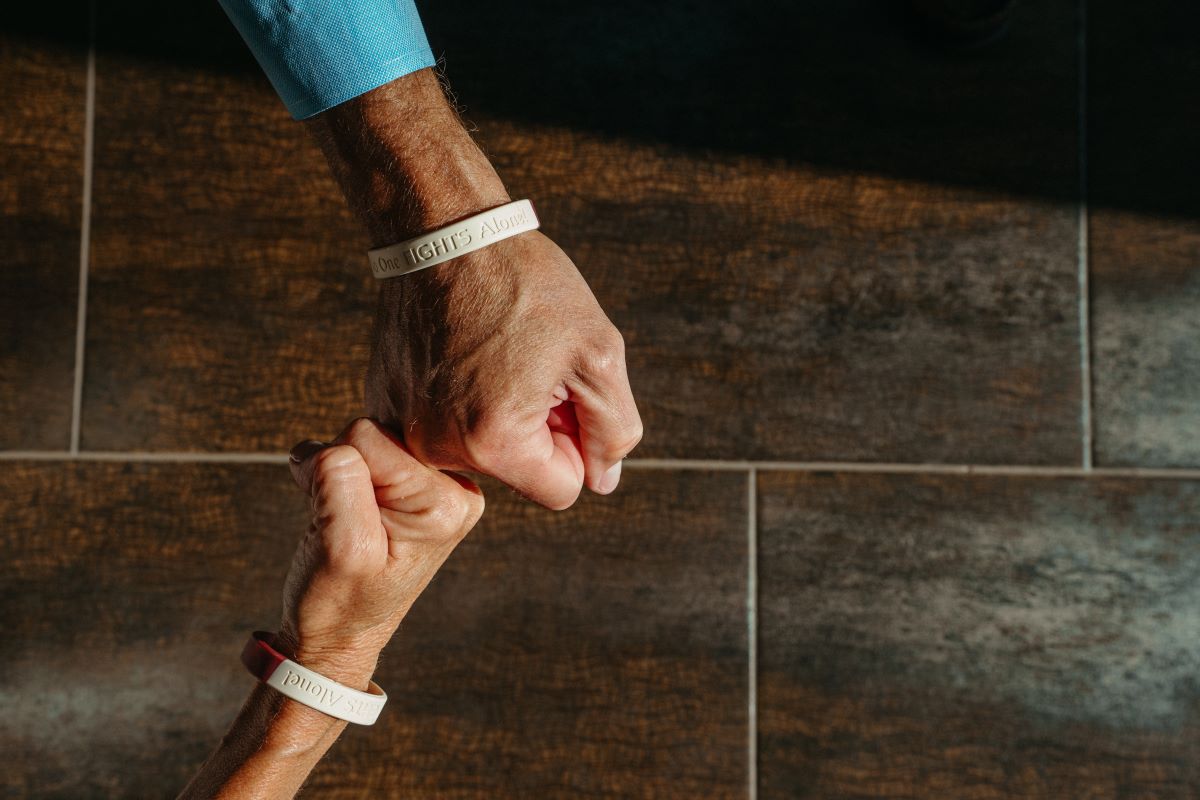
He recalls talking with one woman who was diagnosed with a head and neck cancer that had returned. She said she was tired and didn’t want to fight anymore. In despair, she asked Joe why he fought so hard. Straight from his heart, he poured out his lengthy list of reasons.
“I told her: First, I don’t want to die because I was too young and had more to do. Second, I have three boys and a wife, so I want to fight for more time and memories with them. Third, I want to fight alongside and for all those who are fighting with me because it takes a village—no one fights alone. And fourth, I fight for all the people who fought so valiantly and lost so that they didn’t lose in vain. And lastly, I believe there’s a purpose for me in this journey, and I will fight to see what this purpose is.”
His passionate, fighting spirit inspired the woman. A year later, she called Joe on Christmas Eve to thank him for getting her through a dark time. She fought back and was enjoying the holiday with her daughter— because of Joe.
“That’s the obligation,” Joe says. “Talking with other patients gives me more fuel to help anyone I possibly can whether it’s one-on-one or financially through the Head and Neck Tumor Center at Siteman.”
Championing Excellence in Patient Care
Siteman has long been recognized as a leader in head and neck tumor surgery and reconstruction, radiation oncology, medical oncology, and other related specialties. The Head and Neck Tumor Center, which opened in the new cancer building in the fall, takes a multidisciplinary approach to cancerous and benign tumors of the head and neck.
“They’ve built a high-performing team, and the doctors are second to none,” Joe says. “Dr. Sid Puram brings innovation, a focus on research, and a vision to take head and neck cancer care up several notches through multidisciplinary care, ensuring everything patients need is under one umbrella. They’re adding more patient support and structured survivor care that includes a focus on sleep, nutrition, and mental health to complement the excellent medical and surgical care. With this vision, count me in.”
Joe is excited about what’s on the horizon thanks to additional research, donor support, and the Head and Neck Tumor Center team’s dedication to improving care for patients.
“Robotics has been a game-changer making surgery more precise,” Joe says.
“And AI will play a big role in the future of cancer in general. New tools and research are driving better treatments such as immunotherapy and personalized vaccines. More of this will drive phenomenal success in the future. But it takes time, money, effort, and resources—I’m excited to be part of that.”
Never content to sit on the sidelines, Joe is pushing progress, lifting up others, and expressing gratitude through his own generosity.
“I’m giving back to them because I believe the Head and Neck Tumor Center team saved my life,” Joe says. “I’ve been given a second chance at life and have an obligation to use it for good to help as many people as I can. I feel obligated to not let this opportunity to help pass me by. I need to leverage it.”
 It Takes a Village
Following the mantra of “No one fights alone,” Joe rallied his friends and colleagues to support the naming of The Robert Ebert and Greg Stubblefield Head and Neck Tumor Center. The center is named after two of Joe’s friends who battled head and neck cancers.
Rob served on the World Wide Technology board with Joe. Greg and Joe served on the board of the CEOs Against Cancer – St. Louis chapter. Greg also was Joe’s neighbor, so they frequently took walks together for moral support as they went through treatment around the same time.
The Koenigs’ investment through The Foundation for Barnes-Jewish Hospital, along with other philanthropy, will make possible essential patient navigators and other resources to guide patients through their cancer journeys.
“Joe is on a purpose-driven mission as a survivor,” says Eric Barkley, director of transformational giving and campaign strategy at the Foundation. “We’re grateful for his positivity and leadership that has inspired so many people to come together to raise significant funds to change the trajectory of head and neck cancer care. The vision for the center is exciting, and we’re still working to raise more funds for future steps.”
“It takes a village to make things happen,” Joe says. “That village that supported me is still in play—the friends, family, co-workers, and those who designated money toward the Head and Neck Tumor Center. And it takes a team centered approach to drive the outcome we all want.”
Although Joe has had his own struggles, seeing his friends Greg and Rob battle cancer has strengthened his resolve to rally support for better treatments.
“They both exemplified courage, strength, hope, and optimism,” Joe says. “They fought until the bitter end. That’s why I don’t give up.”
Joe wants to make a difference as a multiplier. “I want to see what comes out of this experience,” he says. “Where am I needed? I will continue to help patients whenever I can because it’s vital to have a support system— you can’t win by yourself. One of the people I mentored even called me a year later to support the Head and Neck Tumor Center with a significant gift to help others.”
As the Head and Neck Tumor Center grows, Joe plans to stay involved to offer patient perspective and insight, as well as support.
“With each phase, we will see what’s missing,” Joe says. “They will need ongoing support. The Head and Neck Tumor Center team has a great vision, and I’m proud and honored to work with them on it. This center will have such an impact on so many people, so I want to see it through fruition. It’s the least I can do—I have a survivor’s obligation.”
The Robert Ebert and Greg Stubblefield Head and Neck Tumor Center is expanding life-changing patient care and research. If you would like to learn more, please contact us at 314-286-0600 or [email protected].
Written by Joyce Romine
Photography by Virginia Harold