The Ruwitch family has a rich tradition of making the world a better place to live. After 30 years of focusing on saving more lives from colorectal cancer, their generosity has significantly advanced research and treatments with more progress underway.
When prominent St. Louis businessman Wally Ruwitch was first diagnosed with stage 4 colorectal cancer at age 50, he barely slowed down. It was 1989, and he continued to build his new business, play golf, and be his usual “life of the party” for several months while undergoing surgery and chemotherapy at the former Jewish Hospital, where he served on the board.
“When Wally was diagnosed, he was determined to fight this and win,” says Ann Ruwitch, who was happily married to Wally for 30 years. “We just followed his lead to how we were going to deal with it.”
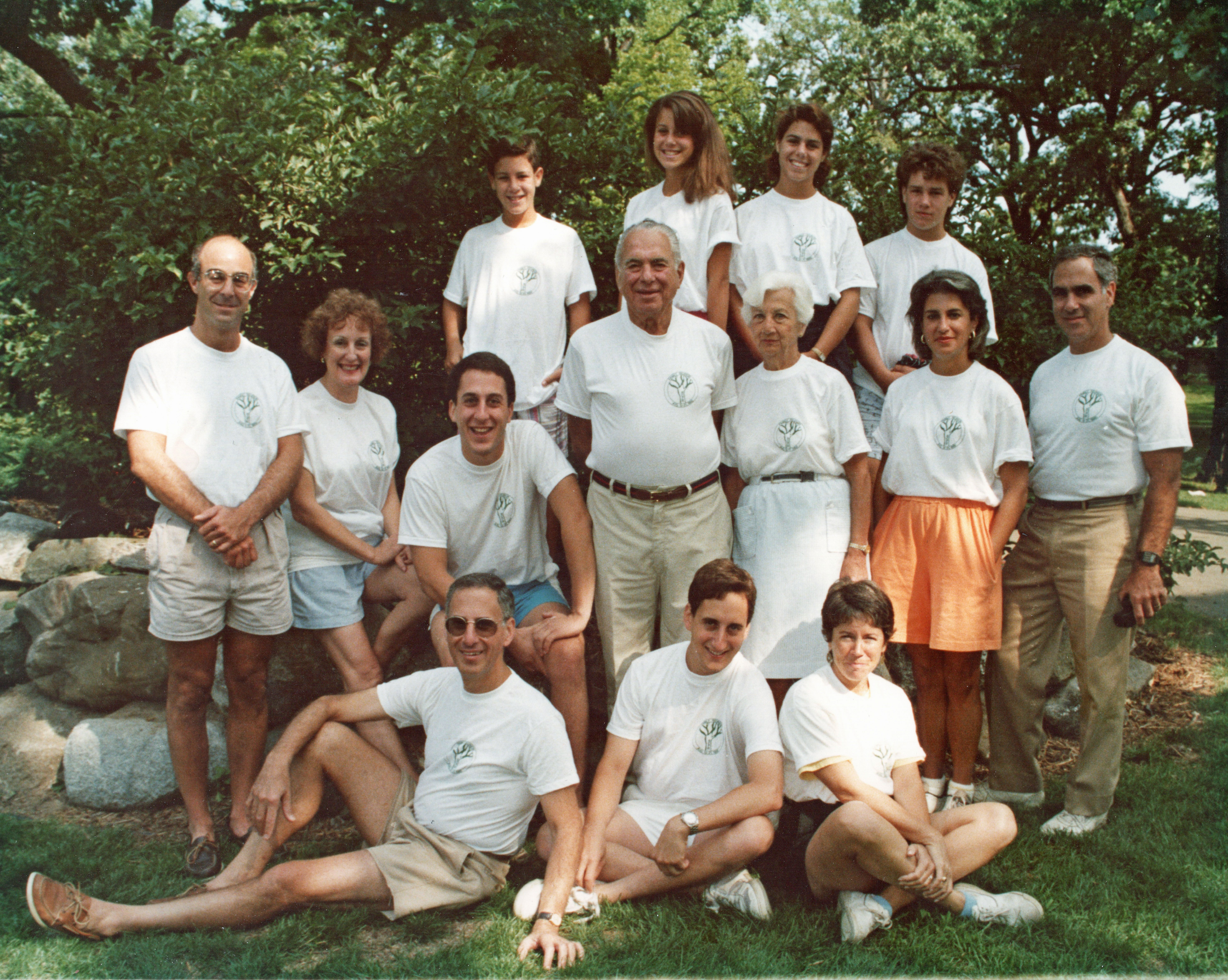
His two sons were just launching into full adulthood. Tom, then 24, was preparing to move to Washington, DC. Meanwhile, Mike, who was 29, was nurturing a management career and a serious relationship with his future wife, Kay.
“My dad traveled and was enjoying his time,” Tom says. “He just kept pushing with a smile on his face and had a great attitude.”
However, eight months after Wally’s diagnosis, the disease began taking its toll, and he began to prepare his family for what was next.
“I was living in Washington, DC, and got a call from my dad about three weeks before he died,” Tom says. “I had no idea how sick he really was at that point. I had let Valentine’s Day pass without sending my mother a card or doing anything. My dad very sternly said, ‘You should never let a holiday like Valentine’s Day or Mother’s Day or her birthday pass without reaching out and telling your mom you love her.’ He kind of let me have it. And he was right. It was the last time he let me have it, and I remember it very fondly. He was thinking about his wife, and I’m sure understanding how stressful and what a terrible spot she was in."
Wally died March 7, 1990, on Tom’s 25th birthday.
A Pioneering Partner
Throughout Wally’s cancer journey, Ira Kodner, MD, was by his side as both Wally’s colorectal surgeon and his close friend.
Dr. Kodner was a pioneer in developing colorectal surgery as a specialty. In 1980, he started the first fully academic program in colorectal surgery in the country at WashU Medicine and was its first chief of the section of colorectal surgery.
His commitment and passion laid the foundation for a successful and visionary colorectal program that continues today. It also became a natural pathway for support for the Ruwitch family, who felt a special connection with Dr. Kodner.
After Wally died, his devastated parents, Elizabeth Renard Ruwitch and Joseph Ruwitch, and his wife, Ann, collaborated to create the Ruwitch Family Endowed Fund in Memory of Wallace R. Ruwitch at The Foundation for Barnes-Jewish Hospital. The fund was merged with a previously established Ruwitch family fund to further patient care and research in colorectal surgery through fellowship training program support.
Taking Charge With a Vision
Although Ann was grieving the loss of her husband, she drew on her strong, take-charge nature to continue her thriving career in leading nonprofits, as well as to engage her family in supporting the Ruwitches’ fund— a role she managed for the past 30 years.
Today, the 85-year-old St. Louis transplant from Bayonne, New Jersey, is renowned for her countless efforts and contributions that have made the St. Louis region stronger, whether as a volunteer, advocate, donor, or among her career roles, including as president of Grand Center for eight years.
“From the beginning of high school, I was always involved and often in charge—I was happy to be in charge,” Ann says.
With her enthusiasm and natural leadership abilities, Ann began gathering her family at least once a year to talk to the doctors and learn what they were doing in colorectal research. As chief of colorectal surgery, Dr. Kodner was a primary source of information for the Ruwitches.
“Ira Kodner is a phenomenal communicator and had a wonderful vision,” Ann says. “He liked to do big things, and that was fun for me because I like to do big things too. I was always so interested and thought it was really important to keep up and to make good relationships with doctors to make for more successful projects.”
Dr. Kodner says the family’s involvement was motivating and personal.
“Each year, Ann presented the check in person to those doing research in colorectal cancer surgery,” he says. “It developed a strong relationship for Ann, her children, and the family with the whole concept of investigative colorectal cancer surgery. As the years went on, the fund supported a lot of the investigative work we did.”
He continues: “The Ruwitch family is a stunning example of how much can be accomplished by a relationship with the community. Their giving is based on their family values that have been passed down for generations. They’ve accomplished a huge amount by supporting young people and science.”
Ann’s son Mike says Dr. Kodner’s legacy and vision made the family’s decision to continue to invest in the colorectal program an easy one.
“There would be none of this without Ira Kodner. His passion for wanting to change things through ingenuity and not being afraid to try something different is amazing. He makes you feel great in wanting to contribute because you know that something he embraces is not going to fail. He is an inspiration to why this is something we will always support.”
Building a Runway for Progress
In 2015, Matt Mutch, MD, stepped into the shoes held by his former mentor, Dr. Kodner, to lead the colorectal division. (His brother, David Mutch, MD, is a professor of OB/GYN at WashU Medicine)
“I was one of Dr. Kodner’s medical students, and he was probably one of the main reasons I ended up in general surgery,” he says.
Leading up to his role as chief of colorectal surgery, Dr. Mutch had been tasked with bolstering research. That’s when he learned of the significant support available from the Ruwitch family.
“The philanthropy that the Ruwitches started 30 years ago is paving the way for the future,” Dr. Mutch says. “I was able to leverage those funds with some young trainees who were interested in coming in to do research. That’s when Dr. Will Chapman Jr. was also a resident and came into our lab. We then hired another trainee, Dr. Phil Bauer, who was funded under the Ruwitches. Between the two of them, research productivity went from six to eight papers a year to over 20 papers a year. We also developed a rectal cancer database and started being able to investigate a lot of novel treatments in rectal cancer. The work over the last decade has brought us to where we are today and is allowing us to continue to move forward.”
Dr. Mutch also points to advancements in care that were directly influenced by the Ruwitches’ fund. This includes becoming national leaders in the use of a five-day radiation treatment for rectal cancer versus the traditional five-week regimen.
“In addition, because of the Ruwitch support, we now have a regular and consistent trainee presence in our laboratory,” Dr. Mutch says.
Dr. Mutch says he has never seen a family so engaged across generations like the Ruwitches.
“Ann is incredibly engaged. She knows what’s going on, and she’s truly interested in what we’re doing. She understands the importance of it. And she’s passed that to her sons and the next generations. It’s important to them, and they make time to meet with us.”
Growing the Generational Impact
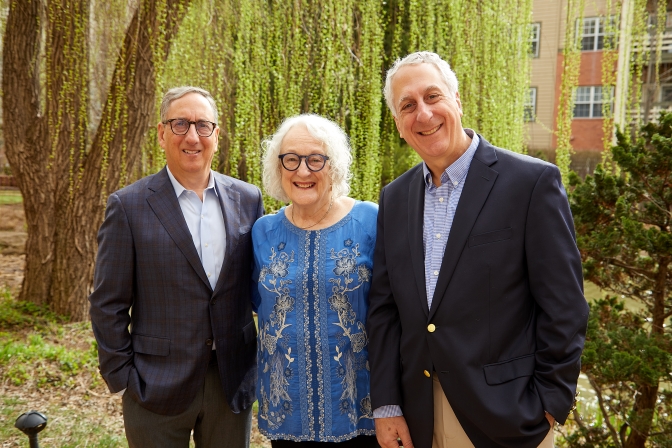
Over the past 30 years, Ann has championed the family fund and has now passed the baton to her sons, Mike and Tom. Inspired by the example set by their parents and grandparents, Mike and Tom are fully engaged.
Tom is also driven by compassion for other families. “When families like ours connect their heart to a cause, it’s rooted in a sad story and heartbreak. What I want to achieve is one less family, 10,000 less families, 100,000 less families, suffering loss and heartbreak. That’s what this fund is for—for keeping families together.”
Mike is excited to grow the family’s impact even more.
“When Tom and I took over our family’s fund from our mother, it was important for us to engage more of our extended family,” Mike says. “We’ve taken the lead on carrying this torch by getting engagement from our entire family and recognizing that it’s our responsibility to make this sustainable to allow the team to do even greater things than what’s been accomplished so far. That’s a great legacy to leave behind.”
At a recent family educational meeting with the colorectal team, Mike brought two of his children, Tucker and Dotsy, where they learned about advances made with support from the Ruwitch family’s funding.
At 32, Tucker is Ann and Wally’s oldest grandchild. “He’s the patriarch of the next generation,” Mike says.
Over the past few years, Tucker has attended meetings with Dr. Mutch and Dr. Chapman, who is now a colorectal surgeon, to learn about the progress the Ruwitches’ fund has enabled. He was impressed with the year-to-year additions of people and programs possible because of the family fund support.
“It really opened my eyes,” Tucker says. “It’s tangible progress, whether it’s the technology being used or the research results. That’s probably one of the coolest aspects about this. There’s a true relation to what this contribution means to progressing the research and hopefully curing the disease. Seeing the impact has been really powerful and continues to make me want to do more and more for this. I never got to meet my grandfather, but having this connection through the fund is meaningful, especially because it’s something that has a larger impact among friends, families, and people in general.”
Another educational meeting included Ann’s niece Lucy Ruwitch Langer, MD, who is an oncologist in Portland, Oregon, and Dr. Langer’s college�age daughter, Hannah, and nephew Zachary. They learned about the advances being made in young-onset colon cancer because of the Ruwitch family’s funding.
“I wanted them to have hands-on, real experiences of what philanthropy means and what it means to be a family doing this together,” Dr. Langer says. “Philanthropy is not just throwing money at an issue. It’s having an impact on real people and real research. I wanted them to meet the people and hear about the research that’s happening to recognize giving can be very meaningful.”
Dr. Langer says Hannah and Zachary both listened intently. “They both felt really proud of the family and saw how the contributions were making a difference for young patients with colon cancer. As an oncologist, I have seen the increasing rates of colon cancer in young people firsthand. This is an urgent issue for all of us.”
The generosity from the Ruwitch and Renard families to the former Jewish Hospital and Barnes Hospital goes back generations with Wally Ruwitch’s parents, Joseph Ruwitch and Elizabeth Renard Ruwitch, being instrumental in the merger of the two hospitals. Through the generosity of Wally Ruwitch’s grandparents, Wallace and Lucille Renard, the Renard Hospital opened at Barnes Hospital in 1955 as one of the first psychiatric units in the country. The Renards also endowed a chair in psychiatry that continues today.
Like the rest of her family, Dr. Langer hopes to encourage the next generation to continue the legacy of giving.
“This fund is an important piece of our heritage, and I wanted to show my daughter and nephew that it’s important to me, to my parents, and to my grandparents to give them a sense of our tight-knit family with strong values.”
In addition, Joe Ruwitch Jr., MD, who is Lucy’s father and Wally’s brother, has reignited his passion for being involved in the fund in recent years as he learned more about the work the colorectal team was doing.
“We’re happy with the progress that’s been made,” Dr. Ruwitch says. “We revered our brother, and we will always miss him and remember him, and we’re happy to be a part of this just like the rest of the family.”
Maximizing the Multiplier Effect
As Ann watches her close-knit family rally around the family’s fund to support cancer advances in memory of a man some young family members never met, she feels immense pride.
“The impact of this fund has grown a lot,” Ann says. “I’m very proud of what the whole family has done. This is the way it should be. Think of the multiplier effect. And that’s important because cancer hasn’t gone away yet."
Written by Joyce Romine
Photography by Alex Kendall