After a devastating lung disease diagnosis, a network of fellow duck hunters supported D.D. Fischer from initial shock to treatment at Barnes-Jewish Hospital. But it was only part of D.D.’s journey—his passion sparked a movement and inspired an entire community to rally around him in support of organ donation and transplant research.
Dwayne “D.D.” Fischer grew up in Quincy, Illinois, where his father and grandfather hunted ducks along the Mississippi River. Hunting, however, was much more than just a pastime for them; they did it to put food on the table.
“Here I am, this river kid. Duck hunting has been in my family. We were poor, but we just didn’t know it,” said D.D., who also became an avid duck hunter. And, like his father and grandfather, he considered duck hunting much more than a sport. But for D.D., it turned out to be a connection he shared with the doctors, caregivers, and friends who had roles in saving his life.
THE STORY BEGINS
When D.D. was diagnosed in 2015 with idiopathic pulmonary fibrosis—an irreversible, progressive scarring of his lungs—he was shocked. He had never smoked, had exercised regularly, and was otherwise healthy.
“The doctor said it was a life-ending disease. ‘Given your age, you probably have 3-5 years unless you get a double-lung transplant,’” D.D. recalled. “I literally walked out of his office crushed. I tried to get my head around the fact I had a disease I’d never heard about, that I wasn’t going to live, and the only answer was a double-lung transplant. I went home with what I thought was a death sentence.”
He didn’t know what to do, so he reached out to a duck hunting buddy for advice. The two men decided that D.D. should get a second opinion from the Mayo Clinic in Rochester, Minnesota, where D.D.’s friend had a contact, a physician who might be able to help speed up the process.
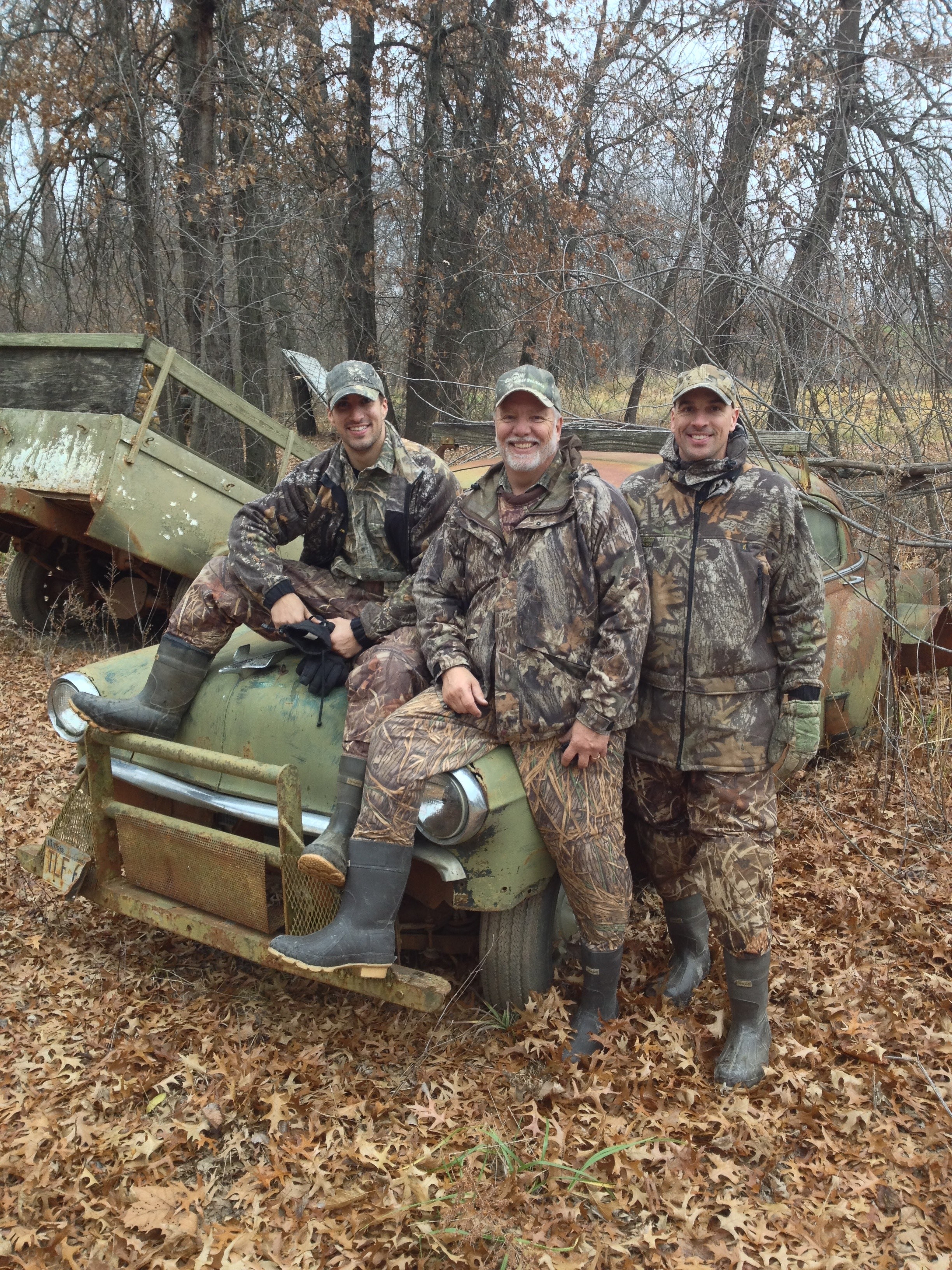 Strangely enough, D.D. actually knew the contact too, but he was just 15 years old when D.D. had first met him on a hunting trip. The inexperienced teen almost wrecked D.D.’s vehicle practicing his driving skills.
Fast forward 30 years, and that teen was now a Mayo Clinic doctor able to refer D.D. into the care of a pulmonologist at the clinic. After 10 months of treatments without success, D.D. was placed on a lung transplant waiting list. But when a year passed with no match, the pulmonologist referred D.D. to Barnes-Jewish Hospital, where he could get dual listed.
AN UNEXPECTED BOND
When D.D. and his wife, Janie, met with Elbert Trulock, MD, a WashU pulmonologist at Barnes-Jewish Hospital, they discovered they had an unexpected bond.
“Dr. Trulock said, ‘Oh, you guys are from Quincy? I know Quincy. I come up to Quincy all the time. I duck hunt there,’” D.D. remembered. “So, the next thing you know, we’re talking about duck hunting. That’s how we got started.”
After D.D. underwent necessary testing, a match was found in just 12 days, and the transplant took place on June 28, 2017. Although it was a success and D.D. says he was given a new life, his challenges were far from over.
In March 2020, he developed a serious type of meningitis that mainly affects people with weakened immune systems. Meningitis is an inflammation of the protective membranes covering the brain and spinal cord. D.D. says that the transplant team met him in the Barnes-Jewish Hospital emergency room and immediately took control. He credits the team’s immediate action with saving his life. He spent 15 days in the hospital and made a full recovery.
Later that year, in November, he spent another 48 days at Barnes-Jewish Hospital with COVID-19, 40 of which were in the intensive care unit. His life was saved once again.
“I’ve lost some lung capacity with the COVID, and it’s probably not going to come back, but you know what? Life is still good…each day is a gift.”
He said that each experience at Barnes-Jewish Hospital gave him an opportunity to see doctors, nurses, therapists, housekeeping and food service staff, and so many more at their best. He described them all as world-class.
“The feeling I got of caring from the doctors and staff goes beyond caregiving; I believe there’s a spiritual side,” he said. “I believe there are so many people at Barnes-Jewish, regardless of what they do, who are living the mission.”
“While medicine is a very technical field, healing and the things that go with it don’t have a lot to do with technicalities,” D.D. says. “It’s the acceptance you feel from physicians and from staff. Something as weird as duck hunting gave us total reassurance that the doctor was looking out for our best interest and he really did know and care about us.”
BUILDING AWARENESS TO SAVE MORE LIVES
In the summer of 2023, the Fischers partnered with The Foundation for Barnes-Jewish Hospital to host a transplant awareness event in their hometown of Quincy. D.D. believed he could be of the most help by sharing his story and raising awareness about the amazing care and treatment he received at Barnes-Jewish Hospital. In that way, he saw himself as more of a “friend raiser” rather than a “fundraiser.” As well-known and active members of their community, D.D. and Janie drew a crowd of more than 100 from the tri-state area.
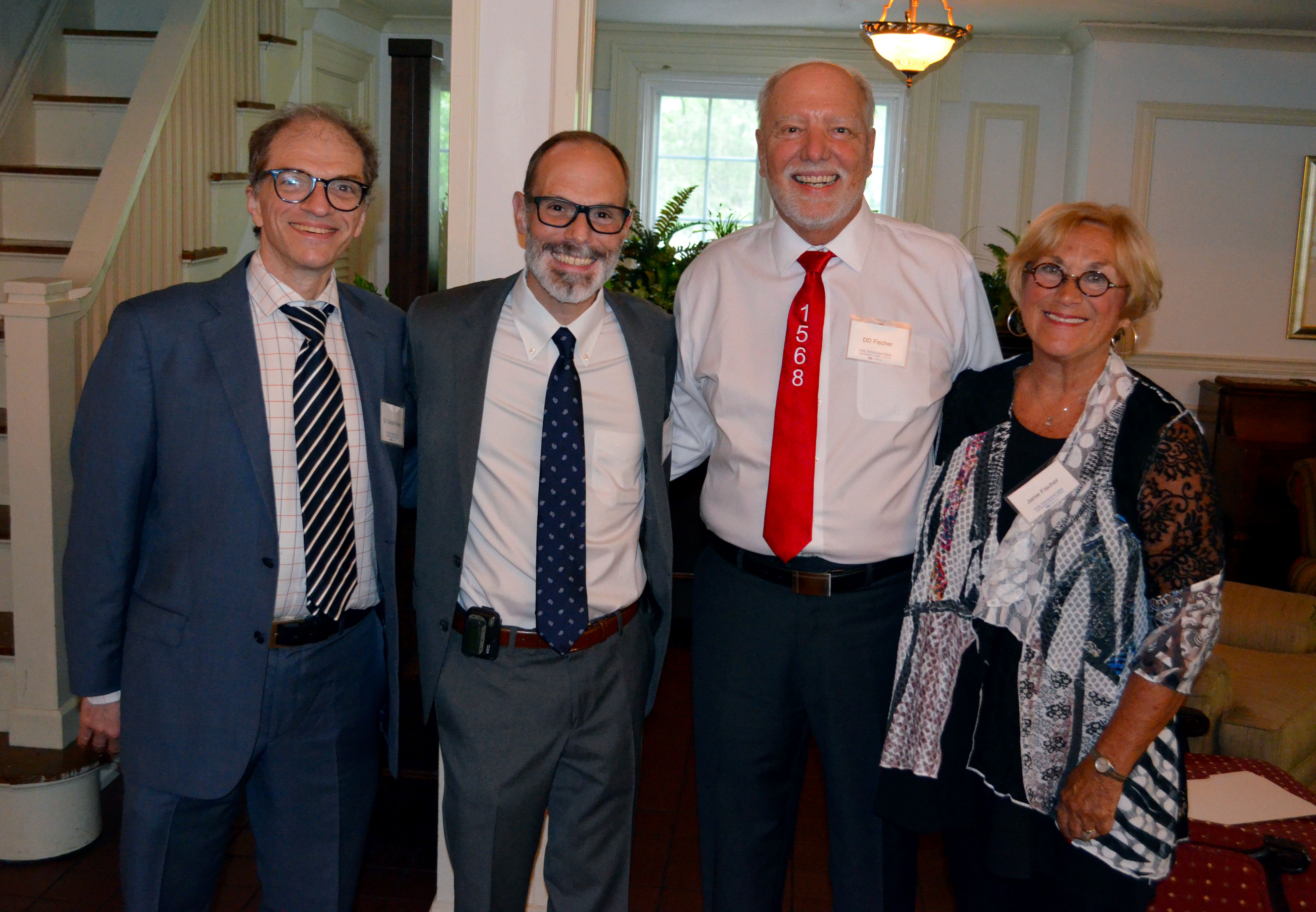
During the event, D.D. shared his personal experience of receiving a double lung transplant. He proudly wore his special tie stitched with a significant number that indicates he was the 1,568th person to receive a lung transplant at Barnes-Jewish Hospital.
In many ways, the gathering was a celebration of life. Several other guests in attendance also had organ transplants. Together, they shared a common, lifesaving bond, and many of them have formed a special support network with each other. D.D. was committed to helping others in the tri-state area who were considering transplant or on a transplant waiting list.
“The number of people who showed up to this event showed the love and respect my parents hold in the community,” says the Fischers’ son Michael. “Numerous people in the Quincy area have received transplants. My dad has leaned on others in the area and has helped others going through transplants, too. He’s here for them.”
“ROCK STARS” SHARE THEIR RESEARCH INSIGHTS
The “star attractions” at the transplant awareness event were two transplant specialists from the Washington University and Barnes-Jewish Transplant Center who spoke and answered questions—Ramsey Hachem, MD, a pulmonologist and the lung transplant program medical director; and Daniel Kreisel, MD, PhD, D.D.’s transplant surgeon. Dr. Kreisel leads the lung transplant program at Barnes-Jewish as the surgical program director and section chief of cardiothoracic transplantation. Both physicians had been a key part of D.D.’s transplant team.
They each gave an educational presentation about their research breakthroughs and the need for more discovery to prevent lung rejection, a common complication of transplant.
“Our friends were so excited to meet these doctors who saved my life,” D.D. said. “And my son Michael considers Dr. Kreisel a rock star.”
Michael says the first time he met Dr. Kreisel at Barnes-Jewish was the day of his dad’s double lung transplant. “When Dr. Kreisel came to tell us that my dad was out of surgery, I was starstruck,” Michael says. “It was very humbling to meet him. So when I heard Dr. Kreisel and Dr. Hachem were speaking at the event in Quincy, I knew I had to come see the guys who saved my dad’s life. It was the scariest time of my life when my dad was going through transplant.”
Michael was impressed by the doctors’ kindness. “When they were leaving Quincy after their presentations, Dr. Kreisel found my mom and asked where I was because he wanted to say goodbye to me. That says a lot about his character.”
RIPPLE EFFECTS OF RESEARCH
In appreciation for D.D.’s care, the Fischers made a gift to The Foundation for Barnes-Jewish Hospital to support transplant research, which created a ripple effect in their family. “The researchers are making incredible breakthroughs,” D.D. said.
After the awareness event in Quincy, Michael wrote his own check to the Foundation to support research. The memo line simply said, “You saved my dad.
“Fighting rejection is the key to the future,” Michael says. “We need to put resources into how to prevent rejection. Guys like Dr. Kreisel and Dr. Hachem give me hope with their knowledge and expertise. We need to support them so they can get to work.”
Michael is proud of the way his dad and brother, Ryan, have supported lung transplant research. Ryan is also working to make a difference as a board member for the Foundation.
“When I talk about organizations like Barnes-Jewish that are really meaningful to me, people hear that,” D.D. said. “They feel those entities are affirmed. Then when that institution asks for donations, the people are in tune. They’ll say, ‘Wow, if that’s important to you, how can I help?’ That’s my approach.”
D.D. valued his extra time deeply, as he reflected in 2023. “I’ve had more than six years with a double lung transplant. I saw my son Ryan start his own business and join The Foundation for Barnes-Jewish Hospital board of directors. I was able to be there when my son Michael got married, and I celebrated our 50th wedding anniversary with my wife. Every day is a gift that someone we didn’t even know gave us through organ donation. It’s the ultimate gift, and I want to express my appreciation and give meaning to that organ donor’s passing. I always say, if you’re not an organ donor, please think about it.”
Michael says having his dad at his wedding meant the world to him. “At the time of our wedding in 2020, my dad wasn’t in good health. But I knew how much my dad cared and knew he was too tough and too positive not to be there. When he took the mic at the wedding, hearing his words and seeing his glowing face hit hard. I’m very thankful for the time I get to spend with him.”
CONTINUING A LEGACY
D.D. passed away on May 2, 2025, surrounded by family at Barnes-Jewish Hospital. He celebrated each day of his nearly eight bonus years post-transplant and ensured that his legacy of service would continue—through the Fischer Family Lung Transplant Research Fund at The Foundation for Barnes-Jewish Hospital, along with a planned gift through his estate.
His gratitude and commitment to giving back will ensure that research scientists and physicians like Drs. Kreisel continue to make strides in transplant research. Inspired by his journey, D.D.’s community of friends and neighbors, fellow duck hunters and fellow transplant recipients, will continue to celebrate his impact.