After Barnes-Jewish Hospital physicians saved her life from severe complications of Crohn’s disease, Cari Goss found renewed strength to climb mountains and help others by supporting life-changing research that’s paying off.
Cari Goss may only stand 5 feet 2 inches tall, but her strength is not to be underestimated. The 53-year-old entrepreneur has fearlessly climbed mountains carrying heavy backpacks, camped in bear country in frigid temperatures, and now, after a near-fatal experience with Crohn’s disease, travels the world to share nature’s beauty through video.
Her strength is only matched by her generosity and faith. Cari’s gratitude to Barnes-Jewish Hospital for saving her life nearly 20 years ago led her to establish the Leo and Carean Goss Crohn’s Disease Research Fund at The Foundation for Barnes-Jewish Hospital in 2010. Cari and Leo also have put the Foundation in their trust and made additional gifts since then to ensure research continues into this devastating disease.
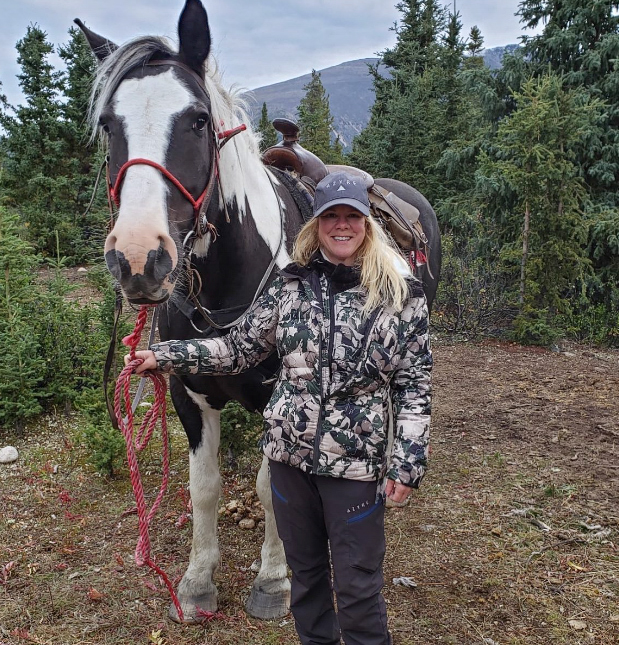 How a Clydesdale Saved Her Life
In her 30s, Cari began suffering from excruciating abdominal pain. She went to numerous doctors around the area of her home in Sheridan, Wyoming, but never received answers or treatment that helped.
“I just kept getting sicker,” Cari says. “They told me it was in my head or to watch my diet because I had irritable bowel syndrome. I was limping, I wasn’t eating, and I lost a lot of weight.”
It was her love of Clydesdale horses that saved her. A friend who worked for the former Anheuser-Busch contacted her about a Clydesdale available in St. Louis. Cari was supposed to pick “Bud” up, but she said she was too sick.
Her concerned St. Louis friend connected Cari to doctors at Barnes-Jewish Hospital. Further testing found a large mass in Cari’s abdomen. Her intestine had perforated and developed into a fistula, or abnormal connection, to her stomach lining, ovary, and a main artery in her leg, which is why she was limping.
“Within 18 hours of arriving at Barnes�Jewish, they had identified the problem,” Cari says. “I soon had surgery to remove my ovary and 4 feet of my colon, but they saved my leg. They couldn’t officially confirm I had Crohn’s disease yet because I had to heal first.” A week later, Cari was on her way back to her home in Wyoming to recover.
“I was so weak and had lost so much muscle mass after almost a year of being so sick,” Cari says. “I was in a wheelchair because I wasn’t strong enough to walk. It took me about a year and half to feel ‘normal’ again. I didn’t think I could ever climb mountains or do what I do now.”
A Quest for Strength and Joy
Cari returned to Barnes-Jewish about 18 months after her surgery to be finally diagnosed with Crohn’s disease at age 36. She began taking medications to manage it, and she remains vigilant about her diet.
“I had a complicated case, and the team at Barnes-Jewish Hospital saved my life,” Cari says. “I’m grateful for that and for the people who cared for me. At Barnes-Jewish, they all work together as a team to do great things to help people. They have a drive and passion for what they’re trying to accomplish.”
Cari identifies with that drive and passion. While Crohn’s disease is a lifelong struggle, Cari refuses to let it defeat her.
In her 40s, she decided to pursue her younger-self’s goal of experiencing a wild sheep hunt in the mountains. “When I was so sick and debilitated physically, I felt like I was going to die,” she says. “After I came home from surgery, I was grateful to be alive and had the opportunity to go on this first hunt.”

These extreme hunts involve being dropped off in remote mountains, riding horses into the mountains, or backpack hiking into them to search for bighorn sheep or other sheep species. Creature comforts are non-existent. Cari has hiked through the mountains carrying heavy gear, waded through icy streams, and endured the elements of rain, snow, and cold for 10 days at a time.
It’s difficult and physically challenging, Cari attests, after 19 sheep hunts and counting. “When I stood on top of the mountain the first time, I knew God had given me the strength to do it. I saw the beauty and felt a sense of peace, love, and joy, along with accomplishment. Now, I travel the world to show this beauty. All things are possible—that’s how I live my life.”
Research Progress Over 15 Years
“When Cari first came to Barnes-Jewish Hospital in 2007, she was on catastrophe’s doorstep,” explains Matthew Ciorba, MD, a WashU Medicine professor and gastroenterologist at Barnes-Jewish Hospital. “She had the worst complications of Crohn’s disease. Thankfully, she has had a good outcome after surgery, and, with medical therapy, she has been able to pursue her passions. That is really our goal for all patients: to live their best lives with little to no impediment from the disease.”
Dr. Ciorba, who is now director of the Inflammatory Bowel Disease (IBD) Center at WashU Medicine and Barnes-Jewish Hospital, wasn’t Cari’s physician at the time, but he was involved in the research focused on genetic and environmental causes of Crohn’s disease that Cari’s generosity supported.
“An important part of Cari’s gift is not only the legacy and duration of it but also the progress that it has spurred over the last 15 years,” he says. “The research that Cari supported early on helped inform the overall understanding of the role of genetics in IBD and Crohn’s disease in particular. In addition, some work that started here, including creating a tissue biobank and database of patients with IBD, has contributed to dozens and dozens of studies.”
More recently, Cari’s support catalyzed personalized medicine approaches for fistulizing Crohn’s disease (FCD), work led by Parakkal Deepak, MBBS, MS, the co-director of the IBD Center and director of Clinical and Translational Research in the Division of Gastroenterology at Barnes-Jewish Hospital. Dr. Deepak’s team is creating 3D cell cultures derived from the fistula tracts of patients as well as using artificial intelligence computer models to identify differences and assess responses to FCD therapies.
“We’re moving closer to precision therapy, therapy selection, and improved therapy with reduced side effects,” Dr. Ciorba says. “In addition, we’re understanding that some therapies don’t work at all in some people and that we have to find new therapies or new combinations of therapies that will.”
Addressing a Growing Problem
The IBD Center is one of the largest in the world and sees more than 10,000 patients each year from a 300-mile radius around St. Louis. The center’s IBD research and clinical group of more than 50 multidisciplinary team members includes physicians, scientists, research coordinators, nurse practitioners, dietitians, psychologists, and others.
“There are only three centers in the country that have the breadth of expertise of specialists that we do,” Dr. Ciorba says.
This expertise is more important than ever.
“Crohn’s is a growing burden across the globe,” Dr. Ciorba says. “It’s becoming an increasingly common disease. We’ve seen a lot of advances in medical therapy, but there is still a lot we don’t understand. Despite the progress we’ve made, there’s no cure; we only have treatments, which don’t work in everyone.”
Compounding the problem is that IBD increases the risk of colon cancer by two to five times depending on the duration of the disease, the extent of inflammation, and how well it was treated. And people with IBD are also more likely to get early onset—under age 50—colorectal cancers.
Dr. Ciorba says more research is swiftly needed to address the growing problem of Crohn’s disease and IBD.
“Philanthropic funding is essential to accelerate breakthroughs in Crohn’s disease and ulcerative colitis research, particularly in discovering innovative methods for identifying new, more effective treatments for inflammation, as well as disease complications such as cancer and fistula. These contributions are the sparks that enable bold and transformative ideas to take root and thrive to attract funding from organizations like the National Cancer Institute.”
He continues: “Donor support has the power to catalyze progress and save lives.”
Creating a Dream Team
Cari is committed to improving lives for people with Crohn’s disease and other related diseases through her support for research. But she wants others to join her mission.
“Doing research takes funding and time and energy from everyone involved,” she says. “I want to support this because once Crohn’s gets figured out, it goes along with other autoimmune diseases, such as rheumatoid arthritis, colitis, and lupus. So then the research would branch out and would heal others. If we all get together and put something in to help for a good cause, it will fix a lot of people and better everyone’s lives. But it has to be a team effort. There are a lot of people with these issues, and I feel like we’re creating a dream team to make something great happen.”
Dr. Ciorba says Cari’s investment and others like hers open the door for greater impact.
“Private philanthropic support is key to early-stage and high-risk, high�reward, high-impact research success. We literally wouldn’t have the five-fold return on investment from federal funding without it,” he says. “This is an amazing moment in IBD science and research at the center because we’ve built this huge foundation that can really be taken advantage of and move things forward so rapidly.”
Cari’s gift has paved the way for initial work by Drs. Deepak and Ciorba to establish a “dream team” at WashU Medicine and Barnes-Jewish Hospital to study opportunities for improving outcomes for patients with fistulizing Crohn’s disease.
Cari says she feels great today. “I’m so grateful for Barnes-Jewish Hospital, and I’m hopeful for the future and the research we’re going to do. The people in research are excited about making a difference, and when you have that, all things are possible.”
Support Crohn's Disease research!
Written by Joyce Romine
Photography by Terence Knudsen